
Digital marketing isn’t going anywhere. AI in Digital Marketing is becoming the game changer: analyzing campaigns, finding patterns, testing different versions of ads, and handling repetitive tasks. And honestly? We may guess that’s wining.
But don’t confuse yourself that with AI doing the whole job.
Ai can’t replace good judgment. It can’t come up with genuinely fresh ideas on demand. It can’t understand people the way a human can. And it definitely can’t tell a story that makes someone stop, feel something, and care. Use AI in Digital Marketing to do more of the busywork. Just don’t hand it the parts that actually require being human.
The marketers who win won’t be the ones fighting AI. They’ll be the ones who know how to use it—like having a ridiculously fast assistant who still needs you to call the shots.
Learn the tools. Keep your human edge. That’s the real advantage.
The AI Revolution in Digital Marketing
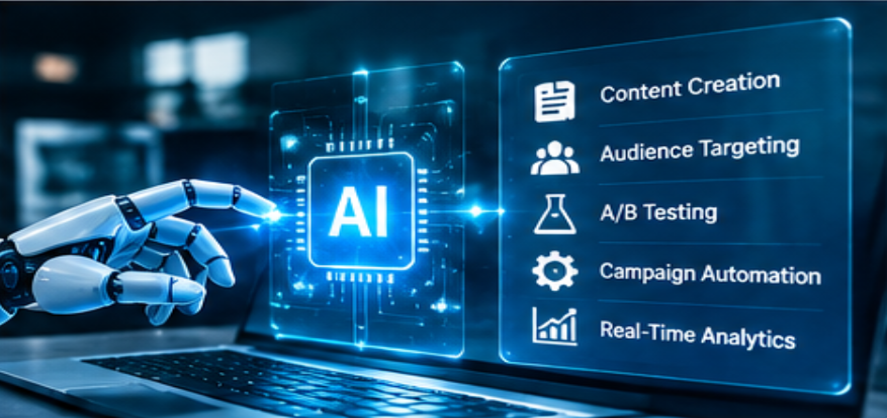
AI in Digital Marketing is changing marketing fast. Not just the tools we use, but how the whole job gets done when ai is there.
By 2026, AI systems will be able to create content, find the right audiences, test what works, adjust campaigns in real time, and tell you what’s driving results. We’re moving from “here’s another AI tool” to AI actually handling entire workflows.
And search is changing too. Gartner expects traditional search volume to fall by 25% as people rapidly turned towards AI such as chatbots and virtual assistants for their answers.
But here’s the thing: that doesn’t make marketers less important. It makes the human part of the job more important.
AI in Digital Marketing does the heavy lifting power as human. Here the main role performed by Humans, it steers the ship, bring the ideas, and take responsibility for the outcome.
What Are the 7 Basic Marketing Concepts?
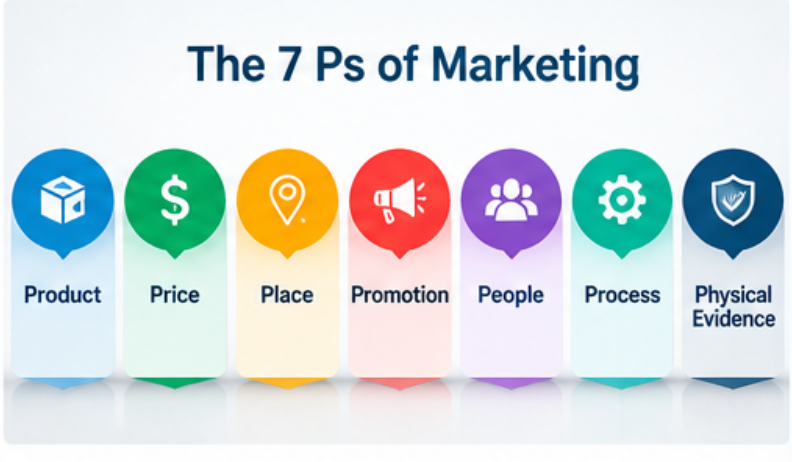
If you want a marketing strategy that actually holds up, start with the 7 Ps. They’re not some dusty textbook theory. They’re the basics you need to get right.
Product: What are you actually selling? Does it really solve the problem? And why should anyone care it?
Price: What are people willing to pay against the good or services? Think beyond the number—discounts, payment options, and that the product feels worth the money all matter.
Place: Where do people buy your product? Your website, Amazon, a physical store, a sales team? Make it easy for customers to find and get what you’re selling.
Promotion: How do people hear about you? Ads, social media, email, PR, content, word of mouth. Pick the channels that actually reach your audience instead of trying to be everywhere.
People: Who express their experience? Your employees, sales team, support staff, partners, even the people representing your brand. Customers remember how they’re treated by the team.
Process: What is behind the scenes? Buying, onboarding, delivery, customer support—all about product. We still can lose the customers for a great product if the experience is a mess.
Physical Evidence: What makes people trust you? Your packaging, website, invoices, store, app, emails, even the little details. If it looks sloppy, people notice.
And yes, all seven still matter in an AI-heavy world.
AI can adjust prices, personalize offers, analyse customer behaviour, and automate a ton of execution. Great. Let it.
But don’t hand it the steering wheel.
You still need humans deciding what to sell, what the brand should sound like, what lines not to cross, and what the customer should actually feel.
Think of the 7 Ps as the foundation. AI gives you more speed and horsepower.
But it’s still your job to know where you’re going.
Is It Worth It to Hire a Digital Marketing Agency?
Those businesses which are growing day by day, yes—it’s absolutely worth hiring a digital marketing agency. Especially if you want to scale faster, make smarter budget decisions, and leverage cross-industry insights that DIY efforts can’t match.
When an Agency Actually Makes Sense
You don’t have the right people in-house. SEO, paid ads, content, analytics—it’s a lot to do well. And marketing after work hours isn’t a strategy.
You’re spending money but can’t see results: You have been running ads, posting constantly, or doing SEO monthly and still can’t able to report your driving sales, something needs to change.
Your competitors snatching your lunch online. If they’re showing up everywhere while you’re barely visible, you need to close that gap.
You’re ready to grow. Maybe you’re getting traction and need more customers, but you’re not ready to hire five different specialists. An agency can give you access to that expertise without building an entire department.
And that’s the big advantage.
A good agency gives you SEO people, ad specialists, content writers, analysts, and strategists under one roof. You also get access to expensive tools and software that probably don’t make sense for you to buy and manage yourself. Just remember: an agency isn’t a magic button. If the strategy is bad, throwing more money at it won’t fix anything. Find people who understand your business, can explain where your money is going, and can show you what’s actually working. That’s when an agency becomes an investment—not another expense.
The Downsides You Should Know

Agencies can be great. They can also get expensive fast.
The bill can be bigger than you expect. Full-service agencies can easily run around $3,000–$12,000 a month for a small or midsize business. Make sure you know exactly what you’re paying for.
The wrong agency can waste your time and money. If they don’t understand your business, communicate poorly, or chase the wrong goals, you’ll feel the pain pretty quickly.
You give up some control. An in-house team is right there with you every day. With an agency, you’re trusting someone outside the business to handle a big part of your marketing.
You can become too dependent on them. If everything lives inside the agency and the contract makes it difficult to leave, you’ve got a problem. Especially if results start slipping.
The biggest thing?
Don’t get distracted by vanity metrics. More followers are nice. More impressions sound impressive. But do they lead to more customers? A good agency should be able to connect its work to things that actually matter: better traffic, better leads, more sales, and higher conversion rates. And in 2026, I wouldn’t frame the decision as agency vs. in-house vs. AI. That’s the wrong question. The better setup is agency + AI + someone on your team keeping an eye on things. Let AI handle the repetitive work and help the agency move faster. Let the agency bring the expertise. Keep someone internally involved so the strategy stays connected to the actual business. That combination can work extremely well. Just don’t outsource your brain along with your marketing.
What Are the Most Common Marketing Problems?
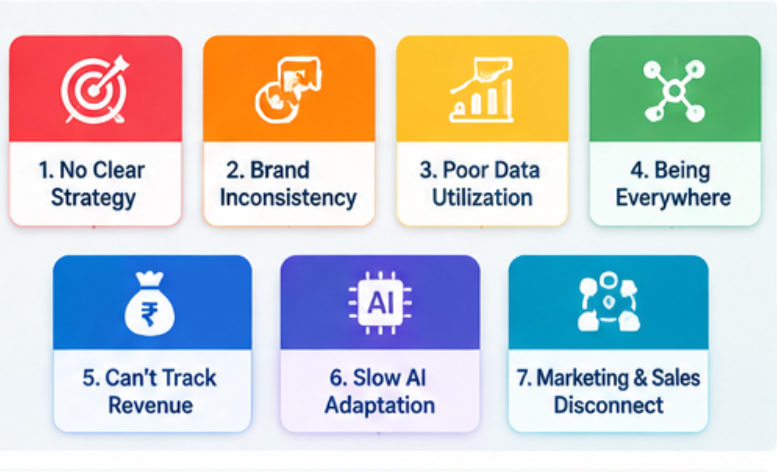
Even with AI, agencies, and more marketing tools than ever, businesses still run into the same problems.
Here’s one of the biggest.
1. No Clear Strategy
A lot of businesses jump straight into doing stuff.
“Let’s post more on Instagram.”
“Let’s run some ads.”
“Should we start a newsletter?”
If you don’t know about who you’re trying to reach the right customer, what you want to do for them, and what success actually looks like, you’re just throwing things at the wall and hoping something sticks.
Solution: Fix it with 7Ps
Get clear on what makes your product worth buying. Figure out exactly who you’re trying to reach. Then make sure your marketing is all pushing toward the same goal.
More leads? Brand awareness? Repeat customers?
Pick the goal first. Then build the marketing around it. Because more activity doesn’t automatically mean better marketing. You don’t need to do more. You need to know what you’re doing and why.
2. Your Brand Sounds Like Five Different Companies
This happens all the time.
One freelancer writes your Instagram posts. Someone else runs the ads. Your email person has their own style. Suddenly, your brand sounds completely different depending on where someone finds you. That’s a problem.
Solution:
Create a simple brand guide that covers your tone, visual style, key messages, and a few clear dos and don’ts.
Nothing fancy. Just enough to keep everyone on the same page. Then make sure every freelancer, agency, or employee actually uses it. Your brand shouldn’t sound different just because a different person opened the laptop.
3. Poor Data Utilization
Most businesses are sitting on a mountain of data. Website visits. Ad clicks. Email opens. Purchases. Customer behaviour. And then… nothing. The problem isn’t usually a lack of data. It’s knowing what to do with it. The fix? Wait till the AI find the patterns, after that use your brain to decide what they mean. Use AI tools to spot what’s changing around and where opportunities for you are hiding. Then act on it. Maybe one ad is bringing in customers at half the cost of another. Move more budget there. Maybe certain customers buy after specific emails. Build around that behaviour.
Don’t collect data just to make pretty dashboards. Use it to make better decisions.
4. You Don’t Need to Be Everywhere
TikTok. LinkedIn. Google Ads. Email. YouTube. Podcasts.
It’s tempting to do all of it. Don’t.
Trying to show up everywhere usually means you’re doing everything badly instead of doing a few things really well.
The fix? Find what actually works and go harder there.
Check your numbers every few months. Figure out which two or three channels are bringing you the best leads or the most revenue. Then focus. Use AI to handle the repetitive stuff on the channels that matter less, and save your time for the work that can actually move the business. You don’t win by being everywhere. You win by being useful in the places your customers already pay attention to.
5. You Can’t Tell What’s Actually Making Money
Someone sees an ad. Then reads a blog post. Gets an email. Watches a video. Comes back through Google. Finally buys. So… which one deserves the credit? That’s where things get stuck. You will observe that a lot of businesses end up celebrating clicks, impressions, and leads without knowing what actually turns into revenue.
The fix? Stop looking for one magic number.
Track the full journey as best you can. Look at which channels influence real customers, not just which ones generate the most activity. Because a channel that brings you 1,000 cheap leads might be far less valuable than one that brings you 50 people who actually buy.
At the end of the day, revenue is the scoreboard.
6. Slow Adaptation to AI and Automation
Some people still avoid AI in Digital Marketing because they’re worried it will end their jobs or make everything more complicated for them. Besides, the competitor is using it to move faster and get more done. The answer isn’t to throw AI at everything. Use it like a really capable assistant. Teach your team how to write better prompts, read AI-generated data, and build simple automations. Then let AI deal with the boring, repetitive work. Your people should spend their time on the stuff AI can’t fake: strategy, judgment, ideas, and creativity.
7. Marketing and Sales Aren’t Talking
This is an old problem, and it still costs businesses a fortune. Marketing says, “We’re sending plenty of leads. “Sales says, “Yeah, but none of them are any good.” And round and round they go. Meanwhile, money gets burned and everyone blames everyone else.
The fix? Get both teams in the same room.
Agree on what a good lead actually looks like. Not “someone who filled out a form.” Someone who has a real chance of becoming a customer. Share the same numbers. Talk regularly. Look at which leads turn into actual sales and feed that information back into marketing. Marketing shouldn’t just chase leads. Sales shouldn’t just complain about them
The Human Edge in an AI-Dominated Landscape
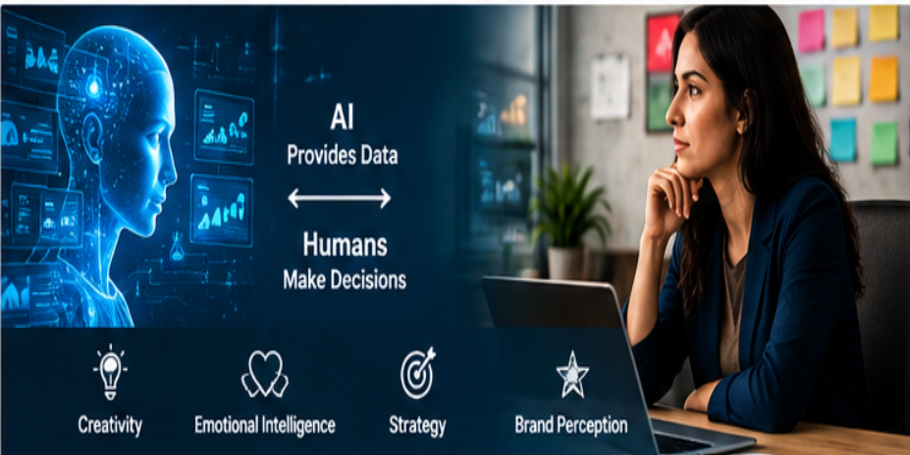
By using AI in Digital Marketing we can write your blog posts, adjust ad bids, and even predict which customers might leave. But it still doesn’t really understand people. It can spot patterns. AI might tell you to offer 20% off because the numbers say it could boost sales. Sounds great.
But what if that discount makes your premium brand look cheap? A short-term bump in conversions might not be worth damaging how people see you six months from now. Or maybe the data says a polished, perfectly optimized ad should win. Then a simple customer video comes along and absolutely crushes it because it feels real. That’s the part you can’t reduce to a spreadsheet.
In 2026 or beyond it, only fittest will survive. Means ones who:
Use AI to replace boring work. Let’s give it to handle the repetitive stuff and give you more time to think, create, and experiment.
Double down on the human stuff. Strategy. Storytelling. Relationships. Knowing what people actually care about.
Keep learning. New AI tools will keep showing up. Learn the useful ones, ditch the hype, and don’t forget the fundamentals—like the 7 Ps.
The goal isn’t to become more like AI. It’s to use AI so you have more time to be a better marketer.
Conclusion: Collaboration, Not Replacement
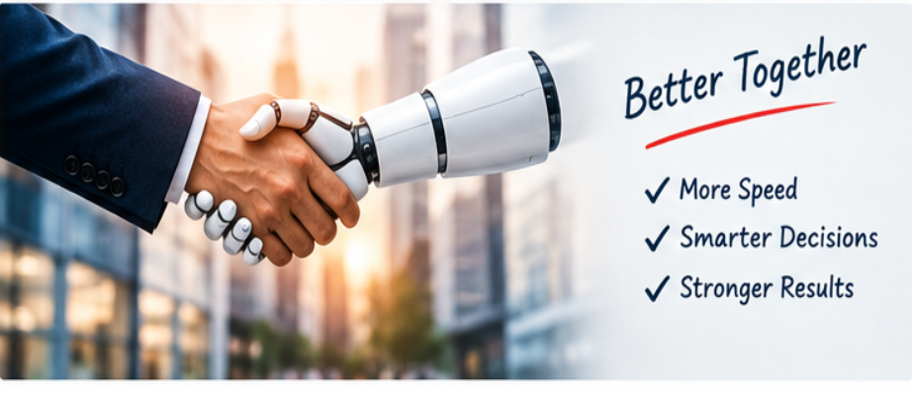
It is not the end of Digital Marketing—it’s evolving. Understand it like: AI is the engine; humans are the drivers. The question isn’t “Will AI replace marketers?” but “How can marketers harness AI to become more strategic, creative, and impactful?” So, it’s changing fast.
AI is going to handle more of the work, but marketers aren’t going anywhere. The real question isn’t, “Will AI replace marketers?”
But don’t throw the basics out the window. Know your customer. Know what you’re selling. Get your positioning right. Remember the fundamentals, including the 7 Ps.
The future isn’t humans vs. AI. It’s humans using AI to do better work. And honestly? That future isn’t coming.
It’s already here.